
Conveyor Belt Repair Adhesive: How to Fix Nylon, EP and Steel Cord Belt Damage
Conveyor belt wear is one of the most common maintenance problems in mining, aggregate handling, cement plants, and port logistics. When surface rubber erodes, cuts appear, or edges begin to split, the decision is straightforward: repair the damaged section now, or risk the damage expanding into a costly full belt replacement.
This guide covers how to assess conveyor belt damage, when a conveyor belt repair adhesive is the right solution, and how to apply HUAYE-3201 conveyor belt repair adhesive correctly to achieve a durable, long-lasting repair on nylon, EP, and steel cord belts.
Common Types of Conveyor Belt Damage That Can Be Repaired
Not every damaged belt needs replacing. The following damage types are typically suitable for repair using a two-component rubber conveyor belt repair adhesive:
① Surface Rubber Wear
The top cover rubber gradually wears through contact with bulk materials, idler rollers, and belt cleaners. When wear is localized and has not reached the carcass, a repair adhesive can rebuild the rubber layer and restore surface integrity.
② Cuts and Tears
Sharp materials — rock fragments, metal debris, broken fasteners — can cut into the belt cover. Small to medium cuts caught early are ideal candidates for conveyor belt repair adhesive before they propagate under load.
③ Local Rubber Loss and Holes
Impact damage or prolonged wear can create voids or holes in the rubber cover. These can be filled and rebuilt using a high-viscosity repair compound that cures to a rubber-like consistency.
④ Edge Damage
Belt edges are exposed to misalignment, material spillage, and contact with conveyor structures. Edge damage that has not compromised the belt carcass can be rebuilt with repair adhesive to restore belt profile and prevent further deterioration.
When to Use Conveyor Belt Repair Adhesive vs. When to Replace
Repair with a conveyor belt repair adhesive is the preferred option when:
- Damage is localized and has not reached the belt carcass or steel cords
- The belt has remaining service life in undamaged sections
- Downtime for full belt replacement is not immediately feasible
- The damage type is surface wear, cuts, holes, or edge loss
Replacement should be considered when damage extends across the full belt width, when carcass integrity is compromised, or when cumulative wear across the belt surface indicates end of service life.
HUAYE-3201 Conveyor Belt Repair Adhesive — See It in Action
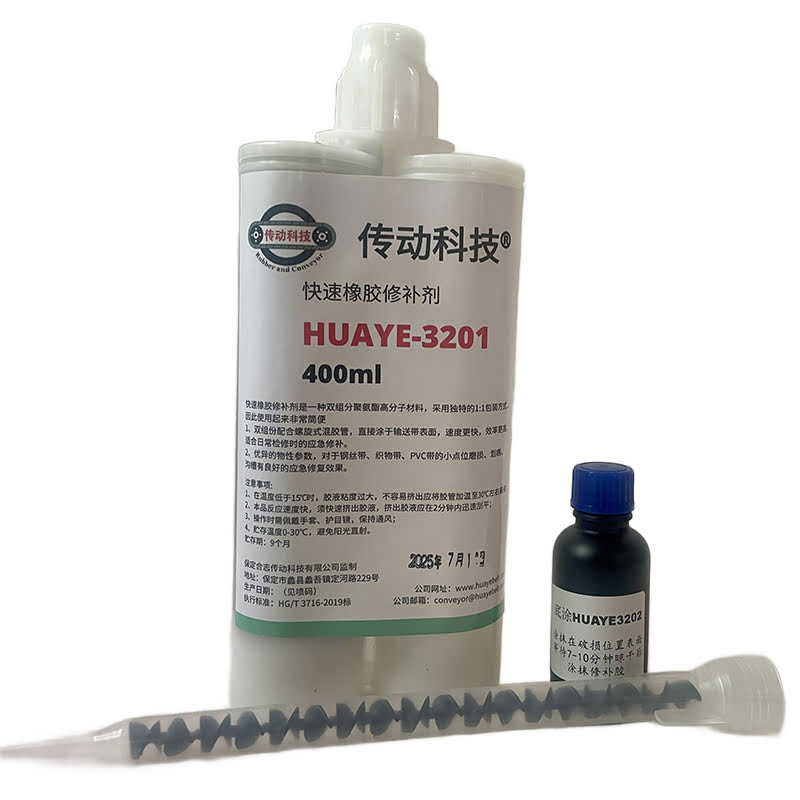
HUAYE-3201 Conveyor Belt Repair Adhesive — Product Overview
HUAYE-3201 is a two-component (A+B) fast-cure wear-resistant conveyor belt repair adhesive designed for field repair of rubber conveyor belts. It mixes and cures at ambient temperature, forming a flexible rubber-like repair layer with high wear resistance and strong adhesion to rubber belt surfaces.
Compatible Belt Types
Key Technical Specifications
| Property | Test Standard | Requirement | Tested Value |
|---|---|---|---|
| Tensile Strength | GB/T 528 | ≥10 MPa | 10 MPa |
| Peel Strength | — | ≥15 N/mm | 16 N/mm |
| Elongation at Break | GB/T 528 | ≥300% | 380% |
| Tear Strength | — | ≥75 kN/m | 78 kN/m |
| Hardness | GB/T 531.1 | Shore A 70–80 | Shore A 72 |
| Cure to Operation (25°C) | — | 60 min | 60 min |
| Heat Resistance (140°C) | — | ≥80% retention | ✓ Pass |
| Working Temperature | — | −10°C to 80°C | — |
Data sourced from in-house quality inspection report, Batch 4-6, June 2025.
Step-by-Step Repair Procedure Using HUAYE-3201
-
1
Clean the Damaged Area
Remove all dust, oil, moisture, and loose or delaminated rubber from the repair zone. The surface must be dry and free of contamination. Any residual moisture or oil will prevent the conveyor belt repair adhesive from bonding properly.
-
2
Grind and Roughen the Surface
Use an angle grinder or abrasive tool to roughen the repair surface and surrounding rubber. This increases the mechanical contact area between the repair compound and the belt, significantly improving adhesion strength. Remove all grinding dust after this step.
-
3
Apply Primer — Required
Apply the bonding primer evenly across the prepared surface using a brush. This step is required — do not skip it. Allow the primer to sit for 15 minutes before proceeding. The primer layer should be thin and uniform; excess primer does not improve bonding.
-
4
Mix and Apply HUAYE-3201
Mix components A and B according to the specified ratio immediately before use. Apply the mixed conveyor belt repair adhesive evenly across the damaged area, filling all voids, worn sections, and cut edges. HUAYE-3201 can be applied in a single pour to any required thickness without significant shrinkage.
-
5
Allow Curing and Return to Service
At 25°C, the repaired section reaches operational readiness in 60 minutes. Do not run the belt under load before this curing period is complete. In cooler ambient temperatures (below 15°C), allow additional curing time before returning the belt to service.
Application Scenario: Aggregate Conveyor Belt Surface Wear
In aggregate handling operations, conveyor belts carrying crushed stone and gravel are subject to continuous abrasive wear on the top cover rubber. After extended operation, the cover rubber in the high-impact loading zone can wear down significantly, exposing the belt carcass to risk.
In this type of scenario, applying HUAYE-3201 conveyor belt repair adhesive to the worn zone — following proper surface preparation — rebuilds the rubber cover and allows the belt to return to service without full replacement. The repair layer, with a Shore A hardness of 72 and elongation at break of 380%, maintains flexibility under load and resists further abrasive wear during continued operation.
Similar repair approaches are applicable in mining, cement conveying, and port bulk material handling environments where localized belt wear is a routine maintenance challenge.
Frequently Asked Questions
HUAYE-3201 is compatible with nylon fabric core (NN) conveyor belts, EP (polyester-nylon) conveyor belts, and steel cord conveyor belts. It is not recommended for high-temperature heat-resistant belts operating above 80°C.
At 25°C, HUAYE-3201 reaches operational readiness in 60 minutes after mixing and application. Full mechanical properties develop over the following hours under normal ambient conditions.
HUAYE-3201 is rated for operating temperatures from −10°C to 80°C, making it suitable for most standard industrial conveyor belt environments.
Yes. The damaged area must be cleaned to remove dust, oil, and loose rubber, then ground to roughen the surface. A bonding primer must be applied and allowed to sit for 15 minutes before applying the repair compound. Skipping surface preparation significantly reduces bond strength.
Yes. HUAYE-3201 conveyor belt repair adhesive can be used to repair edge damage, surface wear, cuts, tears, and local rubber loss on compatible conveyor belt types.
Summary
Localized conveyor belt damage — surface wear, cuts, holes, and edge loss — does not always require full belt replacement. Choosing the right conveyor belt repair adhesive and following proper surface preparation procedures can restore belt integrity and extend service life at a fraction of replacement cost.
HUAYE-3201 provides reliable repair performance on nylon, EP, and steel cord conveyor belts, with a 60-minute return-to-service time and verified mechanical properties from quality inspection testing.
Need a Conveyor Belt Repair Adhesive?
Contact us for product specifications, compatibility advice, or a quotation. Fast response via WhatsApp.